The best...from Gary Van Sickle at Sports Illustrated:
"We learned that 33-7 isn’t the score of a football game but a rule that, if applied universally the way it was to Tiger Woods in Augusta, means no player guilty of a rules breach found after-the-fact should ever be disqualified for signing an incorrect score again. Of course, that’s not how it is going to work for the rank and file. There will be more DQs for wrong cards following post-round penalties. The Masters bent the rules for Tiger. Let me simplify the whole supposedly complicated Tiger issue for you: Yes or no, did Tiger sign for an incorrect score? Correct answer: Yes. He agreed that he took a wrong drop and should’ve had a two-shot penalty included. Tiger should’ve been disqualified. The rest of the story is smoke and mirrors and the more Fred Ridley talked, the worse it sounded. What a stain it would’ve been had Tiger won. He would’ve had to get to 20 majors to beat Jack because this one wouldn’t have counted in the eyes of a lot of observers. Luckily, that’s a moot point now."
The worst...from Gary Player:
"In golf, we have a rules committee, and situations like this are exactly why. When a referee makes a ruling, you have to accept it. It doesn't matter what the commenters on the side say, so why make comments? It makes no difference who thinks Woods should have been disqualified, or who thinks he should have withdrawn. We have to abide the decision. That's how we play golf. Augusta made the final verdict: Tiger broke a rule, and he took his penalty exactly how it was given. No talking can change it, and amen to that."
I used to try not to think Gary Player was a holier-than-thou-chump.
I told him nice up & down once at Valencia Country Club during a Champion's Tour event and he said with a wink, "Thank's, laddy!" It was cool. I was like 40 years old at the time.
Still, what Player misses is that rules evolve from forces applied from both within and without a sport. No ruling body should or can do their work in a vacuum. Commentary, questions and criticism of the rules (and the rule makers) are more than necessary evils, they are the road to better rules.
Friday, April 19, 2013

Tuesday, April 16, 2013
ESPN's Rick Reilly on Sergio Garcia's Demons
This piece by ESPN's Rick Reilly annoyed me on both tone and style points, so I fired off this sharply tongued missive to him:
Dear Mr. Reilly
Really, it's hard for me to figure out why Sergio Garcia's attitude is so interesting to you. He's a golfer; would it be so wrong to judge him by his play rather than dredging up quotes and actions from him going back more than a decade?
Garcia is 33 years of age and has no majors. Then again, Brandt Snedeker is 32, also with no majors, but 3 fewer PGA Tour wins than Garcia. Should we talk about Sned's sunny disposition or his game? In addition to Snedeker, have you ever compared Garcia's career to that of Ian Poulter? Poulter may be trending in the press, but his record doesn't compare.
Garcia finished the Masters at -3, just like Lee Westwood and Matt Kuchar. Has anyone checked their attitudes lately? It would seem not.
I've watched Garcia since the days of his win at the British Amateur and his run at the PGA Championship. Like you, I've wondered about his life away from golf. Also like you, I've not walked a step in his shoes, so I don't question what I don't know.
 Why not? Because it would be like kicking a man whom I don't know. In the end, I was surprised of the mean-spirited feel to your piece. If Garcia has been hard on anyone, it's been himself. If he is man of great talent yet lacking commensurate confidence & joie de vivre, so what?
Why not just leave him to his demons?
But please, refrain from adding your own.
Dear Mr. Reilly
Really, it's hard for me to figure out why Sergio Garcia's attitude is so interesting to you. He's a golfer; would it be so wrong to judge him by his play rather than dredging up quotes and actions from him going back more than a decade?
Garcia is 33 years of age and has no majors. Then again, Brandt Snedeker is 32, also with no majors, but 3 fewer PGA Tour wins than Garcia. Should we talk about Sned's sunny disposition or his game? In addition to Snedeker, have you ever compared Garcia's career to that of Ian Poulter? Poulter may be trending in the press, but his record doesn't compare.
Garcia finished the Masters at -3, just like Lee Westwood and Matt Kuchar. Has anyone checked their attitudes lately? It would seem not.
I've watched Garcia since the days of his win at the British Amateur and his run at the PGA Championship. Like you, I've wondered about his life away from golf. Also like you, I've not walked a step in his shoes, so I don't question what I don't know.

Why not just leave him to his demons?
But please, refrain from adding your own.
Monday, April 15, 2013
2013 Masters: This year's tale of guilt.
In so many ways, Tiger Woods is the perfect counterpoint to Adam Scott.
His failure to hit the gas hard enough on Sunday was blamed on slow greens. Sure, they were trhe very same greens that Cabrera and Scott made epic putts on but, hey, they were just too slow for the stripped one.
Woods debacle at the 15th left me with only one question:
Why did Woods think it was OK to drop a couple yards short of the divot of his previous shot?

I haven't heard anyone ask this question.
In one respect, it doesn't matter: The fact is he made a bad drop and signed an incorrect scorecard.
Game over.
The additional fact is that was only the Masters Rule Committee's failure to identify the penalty in real time, and to notify Woods before he signed his card, that saved him from disqualification.
His failure to hit the gas hard enough on Sunday was blamed on slow greens. Sure, they were trhe very same greens that Cabrera and Scott made epic putts on but, hey, they were just too slow for the stripped one.
Woods debacle at the 15th left me with only one question:
Why did Woods think it was OK to drop a couple yards short of the divot of his previous shot?

I haven't heard anyone ask this question.
In one respect, it doesn't matter: The fact is he made a bad drop and signed an incorrect scorecard.
Game over.
The additional fact is that was only the Masters Rule Committee's failure to identify the penalty in real time, and to notify Woods before he signed his card, that saved him from disqualification.
2013 Masters: This year's tale of redemption.
When Adam Scott blew a four shot lead over the last four holes at the 2012 British Open I wondered if he would ever be able to redeem himself...to himself.
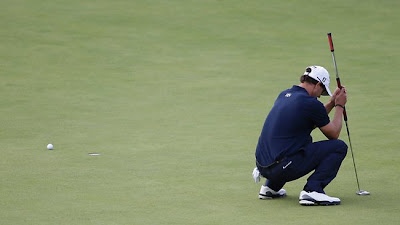
It was the kind of collapse that could have ruined the career of a player like Scott.
Now that Scott has exorcised whatever demons may have remained by his amazing win at The Masters it may be time to start to wonder about his potential to become the best player in the world. One major does not a number one player make, of course, still Scott's the perfect age to become a golfer in full to borrow from Tom Wolfe.
He's long and accurate driver whose short game and new-found fortitude could make him hard to beat. The folks at Nike would like us to imagine Rory McIlroy as his foil, but a slightly younger and just as fit Scott could be the genuine challenger to Woods and the other would-be Number Ones.


It was the kind of collapse that could have ruined the career of a player like Scott.
Now that Scott has exorcised whatever demons may have remained by his amazing win at The Masters it may be time to start to wonder about his potential to become the best player in the world. One major does not a number one player make, of course, still Scott's the perfect age to become a golfer in full to borrow from Tom Wolfe.
He's long and accurate driver whose short game and new-found fortitude could make him hard to beat. The folks at Nike would like us to imagine Rory McIlroy as his foil, but a slightly younger and just as fit Scott could be the genuine challenger to Woods and the other would-be Number Ones.

Friday, March 8, 2013
Am I practicing or playing?
Few who play
golf know the difference, but it's a key question.
Sometimes you practice on the golf course and sometimes you play.
You will be
wise to declare the difference before you tee off.
When you play,
golf is game of fewest strokes. It doesn't matter how you get the ball into the
hole, just do it. Don't take mulligans or re-hit shots or putts that may not
have been hit the way you intended. Focus on numbers, focus on shots; get the
ball into the hole and let nothing stand in your way.
Practice
rounds are usually played when the course is uncrowded and you're playing
alone. You can also have a practice round with your instructor called a
teaching lesson. The circumstances of a practice round don't matter. What does matter
is that you have something in mind when you practice. If a certain shot has
been troublesome, a practice round is a good chance to work on it.
If there has
been a problem shot, take some time to look around and try to see what it is
about the shot that makes it hard.
Is the
challenge visual? In other words, does it really just look hard and cause you
to lose confidence or become uncertain?
Is there a
tricky angle that makes it appear that a tree or other hazard will be in your
way?
Look and think.
Ask yourself
what your common miss looks like on that particular shot. Does is usually go
left or right? Too low? Too long?
Be a detective
& be creative in finding a solution.
Please,
don’t groove a miss!
Even though a
practice round is a good chance to practice tough shots, it's important to
remember not to groove a miss.
Grooving a miss is the foolish practice of hitting a tough shot over and over,
without success. How can you tell if you're really practicing or whether you're
grooving a miss? It's pretty easy: First, make sure the shot is doable. A
doable shot is a shot you can get right over 70% of the time. If the shot has
more of 50% likelihood of success (or less) feel free to try the shot you hit
poorly a second time, but no more.
If you hit the
same shot poorly twice in row move on and forget it for now!
The same is
true for putts. I like to hit lots of extra putts when I play a practice round.
But, I only practice hitting putts that can teach me something about the
green's slope, speed or grain. I won't stand there and hit (and miss) the same
tricky downhill / sidehill left to righter. My confidence is shaky enough. I
want to walk off the green during a practice round knowing more about the way
the green plays than I did when I walked onto it.
After your
practice round sit down and enjoy a Diet Coke. Think about your round. Mentally
break your round up into three parts; your full shots, your short game and your
putts. Ask yourself which of the three were the best and ask which of the three
was not what you'd like it to be.
One of the
best ways to get help from an instructor is to be specific when you ask for
their help. You'll be helping your teacher to help you by asking something
like, "Hey pro, I'm having a lot of trouble making solid contact on my
pitches."
Identifying
issues is a positive way of analyzing your game. Analyzing your game should not be about the minute examination of
every movement and swing element. Analysis your game should focus on specifics
that relate to actual shots. The game is golf, not golf swing.
Improve
your masterpiece.
A practice
round can be some of the most fun and enjoyable golf you'll ever play. A
practice round is like a canvas waiting to be painted. Your job is to imagine
the finished painting, as you'd like it to be to be and then judge your
completed effort when you're done with your round. You will never create the
perfect painting; no one ever has. But, golf will give you an infinite number
of chances to improve on your masterpiece.
Enjoy each
one!
Wednesday, December 12, 2012
Revisionist History is Alive & Well at Golf Digest
Question: Did Martha Burk, who wrote a letter to Augusta
in 2002 and led a protest in 2003, help or hurt the cause?
Answer: I think Burk set back the process by years.
Sometimes a troubling bit of revisionism can reside in a
single sentence. The question quoted above was posed by Golf Digest. The answer
was provided by Golf Digest Editor, Marcia Chambers. As is often the case with
revisionism, I have every confidence most readers will have missed it, or at
least will wonder how it could possibly be relevant.

Chamber’s response revises history by her use of the word, process. Her sentence makes it appear that prior to Martha
Burk there was a process in place at Augusta National to admit women members.
This would be analogous to a contention that Rosa Parks set back the process of
racial desegregation by refusing to sit in the back of the bus in Alabama back
in 1955.
Quite simply, organizations, whether golf clubs or municipal
transit companies, do not like to be told what to do.
As I grow older, even small examples of revisionism are
troubling to me. It’s easy for me to imagine a young person reading Chambers’
quote and imagining Burk as a common rabble-rouser just out to make trouble.
The PGA’s history does not allow for much leeway when it
comes to issues of equality. The end of its Caucasian Clause came in the year
of my birth, 1961. It feels real to me since its stain continued into my own
time.
Too long ago for you? Consider this:
In 1984, Shoal Creek Country Club hosted the PGA
Championship. At the time, the club had no black members. It is stunning to
think that the PGA of 1984 wasn’t savvy enough to be aware of that fact at the
time. If that’s easy enough to forgive, how can we forget that when 1990 rolled
around the PGA again awarded Shoal Creek with its most prestigious tournament?
Though six years had passed, there were still no black
members at Shoal Creek.
Fortunately, the Martha Burks of that time and place were
not silent. The Southern Christian Leadership Conference threatened a boycott
and sponsors like IBM pulled millions of dollars of commercial advertising from
the broadcast. In a matter of weeks, Shoal Creek hastily accepted a local black
businessman as an honorary member.
The only difference between Shoal Creek and Augusta National
is muscle. In 1990, Shoal Creek feared both financial loss and a damaged
reputation. Augusta did a simple calculation based upon the immense wealth of
their brand and decided to weather what in the end was merely a bothersome
squall of adverse of public opinion.
But know this:
Had Martha Burk stayed silent in 2002, today poor Condi Rice
would probably be teeing it up at her local muny. The truth is Martha Burk started the very process Marcia Chambers now says she
delayed.
Augusta National is a singularly magnificent golf course.
Its co-founder, one of the great gentleman of sport this country has even
known. But, its history is always complex and sometimes conflicted.
Subscribe to:
Posts (Atom)